Drywall Crack Repair Las Vegas, NV
Las Vegas has one of the widest temperature swings of any major US city. Summer days reach 115 degrees. Winter nights drop below freezing. That range puts stress on every framing member, every fastener, and every joint in your home. The result is more cracking than you see in most other markets. We repair the crack and address the cause so the same crack does not reopen in the next temperature cycle.
5 Stars
Written Estimate Before Work Starts
Repairs That Hold
Serving All of Clark County
Why Las Vegas Homes Crack More Than Most
Thermal Cycling at Ceiling Seams
Ceiling joints carry the most movement because the roof absorbs direct sun. Vaulted ceilings in Summerlin, Seven Hills, and MacDonald Highlands show cracks at the peak seam where two drywall panels meet. The crack runs straight, parallel to the framing, and reappears each spring if repaired with only a skim of compound.
Truss Uplift at Interior Ceiling Walls
Engineered trusses in homes built from the 1980s onward flex slightly as temperature changes. When the bottom chord lifts in winter, it pulls the interior wall partition with it. The crack shows at the ceiling line where the interior wall meets the ceiling. It is a clean, horizontal crack that closes in summer and reopens in winter. This is not structural damage.
Stress Cracks at Door and Window Frames
Door frames and window frames are rigid points in a flexible wall. As the wall moves with temperature, stress concentrates at the corners of those openings. Diagonal cracks at 45 degrees from the corners of a door frame are the most common pattern. These cracks are cosmetic in most cases but reopen if repaired without addressing the joint.
Why Las Vegas Cracks More Than Other Markets
Las Vegas averages a 30 to 40 degree difference between daytime high and nighttime low for most of the year. Wood framing expands and contracts with that swing every single day. Over years, the joints in your drywall move with the framing. The tape separates. The compound cracks. The crack appears.
Crack Type |
Typical Cause |
DIY Friendly? |
Needs Tape? |
|
Hairline |
Settling, compound shrinkage |
Often yes |
Usually no |
|
Seam |
Failed joint tape/compound |
Sometimes |
Usually yes |
|
Ceiling |
Framing movement, joint failure |
Rarely |
Often yes |
|
Recurring |
Movement or moisture |
No |
Depends |
|
Near door/window |
Wall assembly movement |
No |
Often |
Why the Crack Came Back After Someone Fixed It
The most common reason is a surface skim over failed tape. When a crack opens in your wall or ceiling, it is usually because the joint tape has separated from the drywall paper beneath it. A contractor who applies fresh compound over the old tape without re-taping has not fixed the joint. They have covered it. When the framing moves again in the next thermal cycle, the compound over the failed tape cracks in the same place.
Why It Matters |
What You Get |
|
Inspection first |
Every crack identified before any repair begins |
|
Failed tape removed, fiber mesh re-tape every time |
Thin coat float with proper drying time between coats |
|
Texture sampled and matched before application |
Sidelight check before leaving every job |
How Do I Know If My Ceiling Crack Is Structural or Cosmetic?
A crack that runs parallel to the framing and is under an eighth of an inch wide is cosmetic in most cases. A crack that runs perpendicular to the framing, is wider than a quarter inch, shows vertical offset on either side, or has visible deflection in the ceiling plane should be evaluated by a structural engineer before any cosmetic repair. We do not close structural concerns with compound.
Will the Crack Come Back After You Repair It?
A correctly repaired joint does not crack in the same place. The failure that causes recurrence is covering old tape without removing it. We open the seam, remove the failed tape, re-tape with fiber mesh, and float back in thin coats. Truss uplift cracks may still move at the ceiling line each season, but the correct detail for truss uplift is a control joint or cove, not repeated compound repairs.

How We Repair Drywall Cracks in Las Vegas
Every repair follows the same order. Skipping steps is how repairs reopen.
1) Inspect
We look at the location, orientation, width, and pattern. A straight ceiling seam crack, a 45-degree door corner crack, and a horizontal truss uplift crack each require a different approach.
2) Prep surface
We score and remove the failed tape and loose compound. We do not apply new material over old material that has separated.
3) Treat crack
The new tape needs to bond to clean drywall paper. Any residue or loose compound is cleared before taping.
4) Tape and compound
Fiber mesh tape bonds to the bare paper and holds the joint as the framing moves. Paper tape is used at butt joints where a stronger bond is needed.
5) Feather and sand
Two to three coats of joint compound with drying time between each. Las Vegas heat pulls surface moisture fast. A coat that feels dry on the outside can still be wet underneath. We do not rush between coats.
6) Texture and check
We finish with texture matched to your wall surface and sidelight the repair before we leave. If we see a mismatch, we correct it before we pack up.
What Drywall Crack Repair Costs in Las Vegas
|
Crack Type |
General Range |
|---|---|
|
Short hairline crack, single coat (under 12 inches) |
$75 to $150 |
|
Ceiling seam crack, re-tape and float (12 to 36 inches) |
$150 to $350 |
|
Door or window corner stress crack |
$100 to $250 |
|
Vaulted ceiling peak crack, full re-tape |
$200 to $450 |
|
Truss uplift crack with control joint detail |
$250 to $500 |
What Las Vegas Homeowners Say About Our Crack Repairs
“The ceiling seam at the peak of our great room kept cracking every spring. Two contractors had skimmed over it. You came in, opened the seam, re-taped, and it has been solid for two years.” — Seven Hills, Henderson
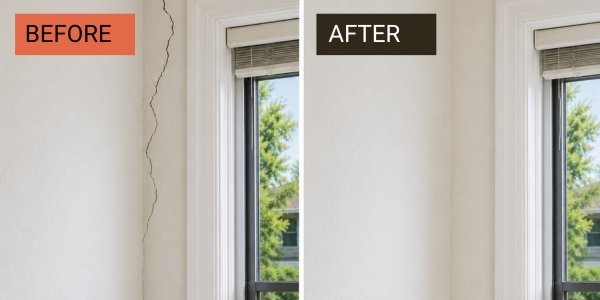
Taped, finished, and built to stay that way.
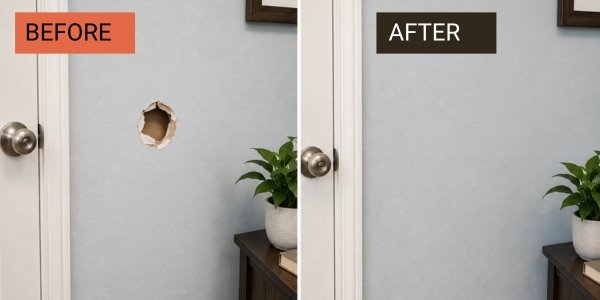
Patched and texture matched. You’d never know it was there.
Drywall Crack Repair Questions Answered
Ready to Fix the Crack for Good? We Cover All of Las Vegas.
Related services: Drywall Hole Repair Las Vegas | Water Damage Drywall Repair | Texture Matching | Ceiling Repair
One call or one form. We respond within one business day. Written estimate before any work starts. Call Now: [PHONE NUMBER] Serving Las Vegas Valley and all of Clark County, NV
Frequently Asked Questions
Why do drywall cracks keep coming back?
Recurring cracks are usually caused by an underlying structural movement — seasonal expansion and contraction, settling foundation, or framing shifts. In Las Vegas, extreme heat cycles put extra stress on homes. If we treat only the surface and ignore the cause, the crack will return. We inspect the cause first before recommending a repair method.
What size crack needs professional repair?
Hairline cracks under 1/8 inch wide are cosmetic and can often be painted over with elastomeric paint. Cracks wider than 1/4 inch, cracks running diagonally from window corners, or cracks that come with sticking doors or windows need professional assessment. These can signal structural movement that paint alone will not fix.
Is a cracked wall a sign of foundation problems?
Not always, but it can be. Stair-step cracks in corners, diagonal cracks from door and window openings, or cracks that appear suddenly after heavy rain or dry spells can point to foundation movement. If you see multiple cracks appearing in different rooms at the same time, it is worth having a structural inspection.
Can paint hide drywall cracks?
Paint can cover hairline cracks temporarily, but it will not stop them from returning. Most cracks need the joint compound to be dug out slightly, refilled, taped if necessary, and sanded smooth before painting. Skipping these steps means the crack will show through within one to two seasons.